
Texsource
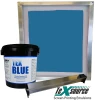
Texsource Tex-Blue Photopolymer Emulsion
- SKU:
- TEX-BLUE-GAL
- MPN:
- TEX-BLUE-GAL
- Condition:
- New
- Availability:
- In Stock
- Weight:
- 11 LBS
- Shipping:
- Calculated at Checkout


Description
Screen Printing Emulsion | Ready-to-Use 1-Part Pure Photopolymer | 8x Faster Exposure | High 45% Solids Content
EMULSION TYPE
SOLIDS CONTENT
EXPOSURE SPEED
INK COMPATIBILITY
Overview & Shop Floor Performance
Texsource Tex-Blue is a professional-grade, ready-to-use SBQ-photopolymer direct emulsion engineered specifically for screen printers needing ultra-fast exposure times and thick stencil bridging. With an impressive 45% solids content and high viscosity, Tex-Blue creates a dense, sharp stencil with fewer coating passes—dramatically reducing drying and prep time across all mesh counts.
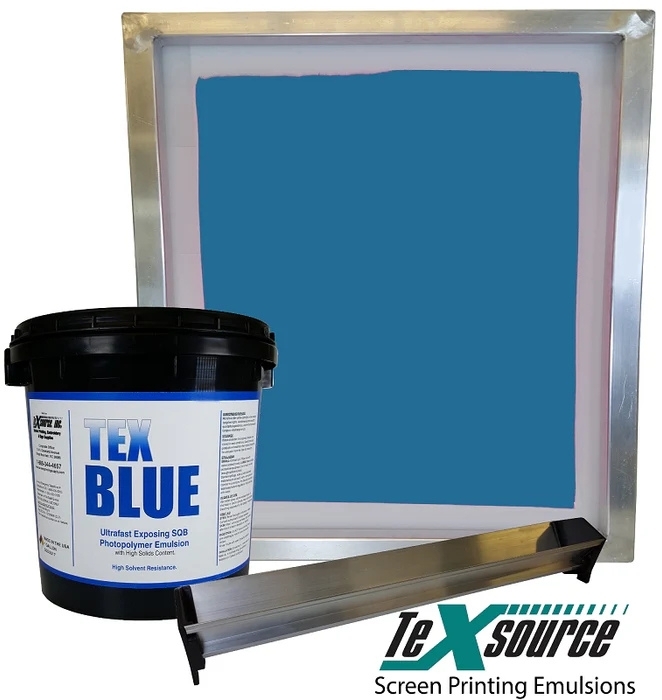
- Ready to Use (No Diazo Required): Eliminates mixing hassle and extends shelf life up to 24 months (2 years) at room temperature.
- Optimal for Weak or LED Light Sources: Exposes up to 8x faster than standard 2-part dual-cure emulsions, preventing bottleneck delays in your screen room.
- High Humidity & Wear Resistant: Formulated so coated stencils won't become tacky or soft under humid shop conditions.
- Effortless Washout & Reclaiming: Breaks down rapidly with standard stencil removers in automated reclaim tanks or manual wash booths.
- Optional Diazo Boost: Can be sensitized with Diazo 11 when extreme edge resolution or aggressive water resistance is needed.
Standard Screen Room Application Procedure
Technical Specifications & Exposure Reference
| Parameter | Specification / Target Value | Shop Notes |
|---|---|---|
| Color / Dye | Deep Blue | High contrast for easy on-screen inspection |
| Solids Content | 45% (± 2%) | High viscosity, optimal EOM stencil build |
| Shelf Life | 24 Months (2 Years) | Store between 37°F–80°F (Do not freeze) |
| LED UV Exposure | 20 – 45 Seconds (Baseline) | Varies by mesh count & emulsion thickness |
| Metal Halide (5kW) | 30 – 60 Seconds (Baseline) | Much faster than traditional dual-cure inks |
| Fluorescent Tubes | 90 – 180 Seconds | Ideal for shops with lower-output light sources |
Frequently Asked Questions & Troubleshooting
Q: Do I need to mix diazo powder into Tex-Blue before using it?
A: No. Texsource Tex-Blue is a pre-sensitized, 1-part SBQ pure photopolymer emulsion ready to coat straight from the container. It offers a 2-year shelf life under proper storage conditions.
Q: Why is my stencil washing out or breaking down during sprayout?
A: Photopolymer emulsions require full exposure to achieve cross-linking. Washout failure is almost always caused by underexposure or screens not being completely dry prior to exposure. Use a 21-step exposure calculator to calibrate your lamp output.
Q: Can I use Tex-Blue with water-based or discharge inks?
A: Tex-Blue handles solvent and UV inks with ease. For high-volume water-based or aggressive discharge ink runs, we recommend sensitizing with Diazo 11 or applying an emulsion hardener to extend stencil durability.
Complete Your Screen Room Workflow
Ensure pinhole-free stencils and smooth reclaim cycles by pairing Tex-Blue with matched prep and reclaim chemistry:
- Application: Pair with an Aluminum Dual-Edge Scoop Coater for uniform emulsion thickness.
- Mesh Prep: Clean screens with our Screen Printing Degreaser & Mesh Prep prior to coating to eliminate fish-eyes.
- Stencil Reclaim: Rapidly dissolve stencils with Concentrated Stencil Remover without etching the polyester mesh.
Screen Printing Industry News and Information
Industry news, educational resources, best practices, and practical screen room protocols provided by ScreenPrintingInsights.com.
Additional Information
Product Sizes: |
Quart - Gallon |
Printing Process: |
Screen Printing |
Related Products
Related Products

Nubtex Shop Cloths 13" x 13" Blue #313 from Fiberweb (15 bundles/case)
Fiberweb

Lithco Blue Denim Printer's Apron
Lithco
AB Dick Blankets - Lithco Premium Blue
Lithco

Hand Armor® GEOTEX GRIP™ Textured Nitrile Gloves 8 Mil - Case of 1000
Hand Armor®