
Spectrophotometer vs. Densitometer: Which Do You Need?
Spectrophotometer vs. Densitometer: Which Do You Need?
Is your print shop relying on "good enough" color, or are you hitting the bullseye every single time?
For commercial printers and Quality Control (QC) managers, the difference between a profitable job and a costly reprint often comes down to one thing: measurement. But when it comes to equipping your pressroom, the terminology can get confusing. Do you need a rugged workhorse like a densitometer, or do you need the sophisticated spectral data of a spectrophotometer?
Choosing the right instrument isn't just about budget—it's about matching the tool to your specific workflow, whether you are managing simple CMYK offset jobs or complex packaging with strict brand spot colors.
In this guide, we break down the differences, explain the "lingo," and help you decide which BetaColor Presto device belongs in your hands.
1. The Densitometer: The Pressroom Workhorse
Best for: Controlling ink film thickness and basic CMYK process stability.
Think of a densitometer as your daily speedometer. It doesn’t tell you what color you are printing (it assumes you are printing Cyan, Magenta, Yellow, or Black); it tells you how much ink you are laying down.
For decades, the densitometer has been the standard for monitoring Optical Density (OD).
Key Functions of a Densitometer:
- Solid Ink Density: Ensures you are hitting the target ink thickness.
- Dot Gain (TVI): Measures if your halftones are printing too heavy (dark).
- Gray Balance: Checks if your CMY overprints look neutral or have a color cast.
If your primary focus is keeping your CMYK process colors consistent during a press run, a dedicated densitometer is a cost-effective, rugged solution.
Recommended Product: The
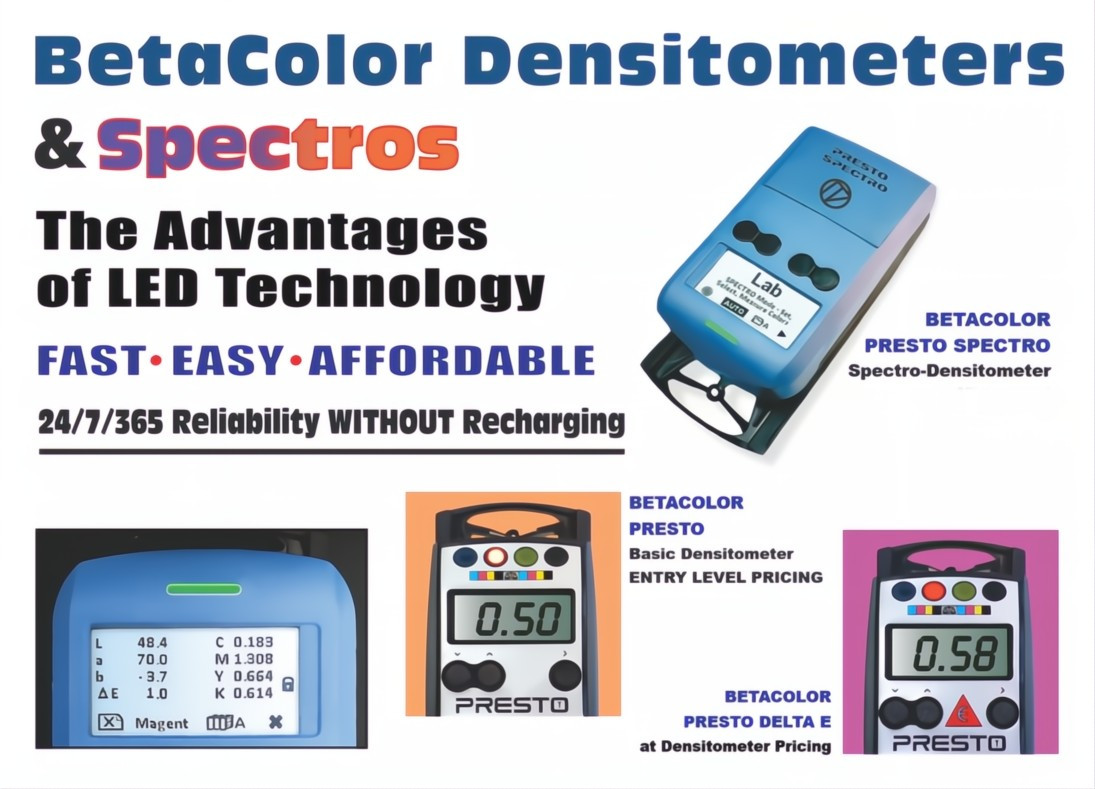
is the industry standard for efficiency. It features automatic "Magic Color Match" technology that instantly recognizes the color you are measuring, allowing operators to make quick adjustments without navigating complex menus. BetaColor Presto Densitometer
2. The Colorimeter: Bridging the Gap with Delta E
Best for: Printers who need to match a customer's signed proof but don't need full spectral analysis.
Sometimes, density isn't enough. You might be hitting your density targets, but the customer says, "That blue looks wrong." This is where Delta E (ΔE) comes in.
A device like the BetaColor Presto Delta E goes a step further than a standard densitometer. It calculates the color difference between your press sheet and the approved proof.
Why Step Up to a Delta E Device?
- Customer Confidence: You can prove to a client that the color match is within industry tolerances (e.g., ΔE < 2.0).
- G7 Gray Balance: Essential for modern "print-by-numbers" workflows.
- Efficiency: It combines density functions for the press operator with color difference data for the QC manager.
Recommended Product: The
offers the best of both worlds. It provides the density data your pressmen need to run the machine, plus the Delta E readouts required to verify the final product matches the customer's expectations. BetaColor Presto Delta E Colorimeter
3. The Spectrophotometer: The Ultimate Authority
Best for: Packaging, high-end commercial print, and Brand Color (Spot Color) control.
If you print packaging, logos, or Spot Colors (Pantone™), a densitometer is blind.
A spectrophotometer measures the actual "DNA" of the color (Spectral Data).
Critical Features for Modern QC:
- Lab* & Lch Values: The precise coordinates of a color in 3D color space.
- SCTV (Spot Color Tone Value): The modern ISO standard for measuring spot color tone value (essential for packaging).
- Opacity & Trapping: Advanced metrics for ink-on-substrate performance.
- No Recalibration Needed: Advanced LED engines (like those in the Presto Spectro) maintain accuracy for years without the drift found in older tungsten-bulb devices.
Recommended Product: The
is the flagship solution. It handles everything a densitometer does, plus it offers full spectral analysis, Lab* measurement, and SCTV capabilities. It is the "Swiss Army Knife" of print quality control. BetaColor Presto Spectro Spectro-Densitometer
Summary: Which One fits Your Shop?
Still unsure? Use this quick checklist to find your match:
- Choose the
Presto Densitometer - You mostly print 4-color process (CMYK).
- Your main goal is process control (keeping ink levels consistent).
- You want a rugged, easy-to-use tool for press operators.
- Choose the
Presto Delta E Colorimeter - You need to verify G7 gray balance.
- You need to report "Pass/Fail" color differences (Delta E) to customers.
- You want an affordable middle-ground between density and spectral data.
- Choose the
Presto Spectro -
- You print packaging or use Spot Colors / Pantone™ inks.
- You need to measure SCTV (Spot Color Tone Value).
- You require full ISO compliance and Lab* color data.
- You want one instrument that does absolutely everything.
Ready to upgrade your print quality? Browse our full collection of
Recent Posts
-

Flint Group Renames itself as Flint Group Packaging Solutions
Industry News from Inkworld Magazine about our key manufacturer of pressroom chemicals, Flint! In a …Apr 3rd 2026 -

The Commercial Printer’s Guide to KMI High-Reactivity LED-UV Inks for Heidelberg and Ryobi RMGT Presses
The Commercial Printer’s Guide to High-Reactivity LED-UV Inks for Heidelberg and Ryobi RMGT Presses …Mar 12th 2026 -
The 2025 Printing Industry Census from Printing Impressions - Download the FREE REPORT!
From our friends at Printing Impressions - Download thier Free report! A Comprehensive Profile of To …Feb 11th 2026