
Offset Printing Industry Trends 2026: Market Data, Growth, and What Is Changing
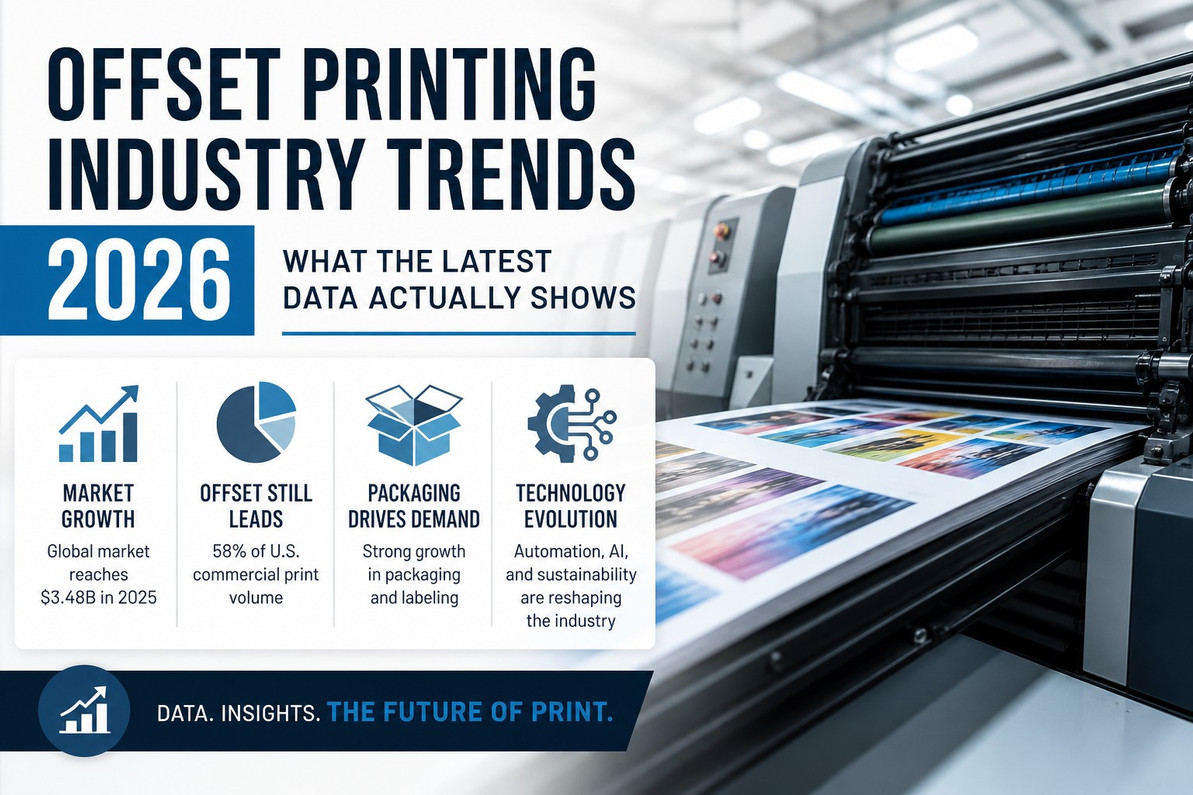
Offset Printing Industry Trends 2026: What the Latest Data Actually Shows
The conversation around offset printing has been shifting for years. You will hear everything from “it is declining” to “it is evolving,” often in the same discussion. The reality sits somewhere in the middle, and the data tells a much clearer story than opinions ever will.
If you step back and look at the numbers, offset printing is not disappearing. It is changing shape, adapting to new demand, and holding its ground in areas where scale, consistency, and cost efficiency still matter most.
For a full breakdown of current data points, you can reference our complete offset printing industry statistics page, but here is what stands out right now.
The Market Is Still Growing, But Not Everywhere Equally
One of the more surprising data points, highlighted in our latest offset printing statistics, is the projected growth of the global offset printing market. Current estimates show the market at roughly $3.48 billion in 2025, with projections reaching over $11 billion by 2034.
That kind of growth does not happen in a declining industry.
At the same time, when you look at offset printing services overall, growth is much more modest. The services market is expected to move from around $309 billion to $339 billion by 2030. That is steady, but not explosive.
What this tells us is simple. Growth is happening, but it is concentrated in specific segments, not evenly across the board.
Offset Still Dominates High Volume Printing
Despite the continued rise of digital printing, offset remains the go to method for large scale production.
In the United States, offset printing still accounts for about 58 percent of total commercial print volume. That is not a niche position, that is dominance.
This makes sense when you look at the types of work involved.
- Catalogs
- Magazines
- Packaging
- High color accuracy projects
These are not easily replaced by digital processes at scale. Offset continues to win where consistency, cost per unit, and color control matter.
Packaging Is Driving Stability
If there is one segment keeping offset printing firmly in place, it is packaging.
Even as traditional print volumes decline in some areas, packaging and labeling continue to grow. That segment alone is projected to expand steadily through 2030.
This shift changes the narrative. Offset printing is no longer tied as heavily to traditional commercial print as it once was. Instead, it is increasingly aligned with packaging, product labeling, and specialty applications, areas that are not going away.
Technology Is Quietly Reshaping the Industry
A lot of the conversation around printing technology focuses on digital, but offset is evolving too, just in less obvious ways.
Automation and AI are becoming standard in modern pressrooms. Reports indicate that over 80 percent of print organizations are increasing investment in AI driven workflows.
- Predictive maintenance
- Workflow automation
- Production optimization
At the same time, sustainability is becoming a real factor. Eco friendly inks, LED UV curing, and reduced waste processes are becoming expectations across the industry.
Offset printing is not static. It is modernizing behind the scenes.
Digital Growth Is Not Eliminating Offset
Digital printing is growing faster in terms of percentage, but that does not automatically translate into replacement.
In reality, digital and offset are settling into distinct roles.
- Digital handles short runs and customization
- Offset handles scale and efficiency
Instead of one replacing the other, the industry is splitting into specialized production methods. That creates a more stable long term environment than a simple winner takes all scenario.
Regional Growth Is Shifting
Another trend worth watching is where growth is happening. Regions like Asia Pacific continue to dominate overall market share, while areas like the Middle East and Africa are showing some of the fastest growth rates.
This reflects broader global manufacturing and packaging demand, not just printing trends. The future of offset printing is increasingly tied to global production and supply chain dynamics.
What This Means for the Industry
When you put all of this together, a clearer picture emerges.
- Offset printing is not declining, it is evolving
- Growth is tied to packaging and specialty applications
- Technology is improving efficiency, not replacing the process
- Digital and offset are coexisting, not directly competing
The companies that understand this shift are the ones that will continue to perform well. The ones still treating offset as either disappearing or unchanged are the ones that tend to struggle.
Final Thought
The biggest mistake people make when talking about offset printing is trying to simplify it into a single trend. The reality is more nuanced.
Parts of the industry are shrinking. Other parts are growing. And the overall system is adapting.
If you want to stay grounded in what is actually happening, the best approach is to keep coming back to the data.
You can view the full set of current data points here:
https://stargraphicsupplies.com/pages/industry-reference/offset-printing-industry-statistics.html
Recent Posts
-

PRINTING United Alliance economist with his industry forecast
Graphics Pro Magazine has a new article in it's latest publication (September 25, 2026), that is a f …Sep 25th 2026 -

Loupe Americas 2026 Trade Show
Our friends at Label and Narrow Web magazine Have some interesting industry news in this month's ed …Aug 27th 2026 -
Fujifilm North America Sells Screen and Flexo Ink Unit to Nazdar
Our friends at InkWorld Magazine have published a great article on the latest news in ink manufactur …Jul 13th 2026